Skip to content

spectroscopysh.com

    spectroscopysh.com
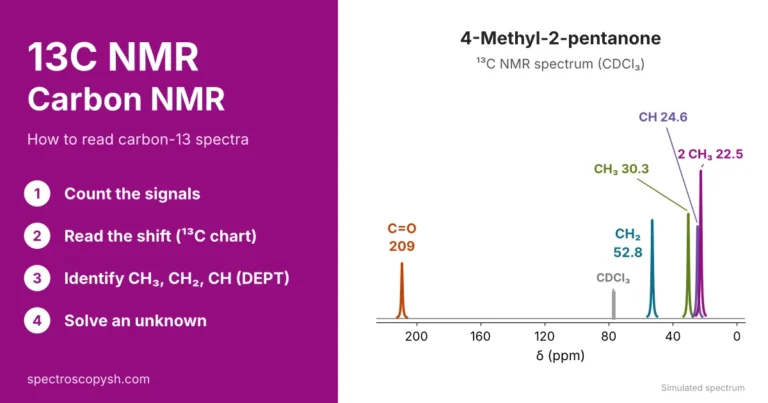
    • 13C NMR (carbon NMR) spectrum of 4-methyl-2-pentanone with C=O at 209, CH2 at 52.8, CH3 at 30.3, CH at 24.6 and 2 CH3 at 22.5 ppm
      NMR Spectroscopy

      13C NMR (Carbon NMR): How to Read Carbon-13 NMR Spectra Step by Step

      ByDr. Shammas Din November 16, 2026November 16, 2026

      13C NMR (carbon NMR, also written C13 NMR, C-13 NMR or CNMR) is the nuclear magnetic resonance spectrum of the carbon-13 atoms in a molecule, so it shows the carbon skeleton. To read a 13C NMR spectrum, answer three questions: how many signals (kinds of carbon), where they appear (chemical shift, δ) and what type…
      Read More 13C NMR (Carbon NMR): How to Read Carbon-13 NMR Spectra Step by StepContinue

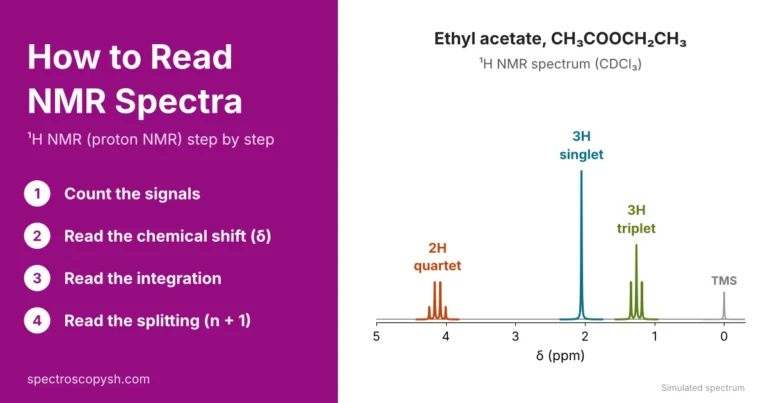
    • How to read NMR spectra: 1H NMR spectrum with number of signals, chemical shift, integration and n + 1 splitting
      NMR Spectroscopy

      How to Read NMR Spectra: ¹H NMR (Proton NMR) Interpretation Step by Step

      ByDr. Shammas Din November 15, 2026

      How to read NMR spectra: to read an NMR spectrum, answer four questions: how many signals (kinds of hydrogen), where they appear (chemical shift, δ), how big they are (integration) and how split they are (number of neighbouring protons, n + 1 rule). Each answer gives one piece of the molecule; together they give the…

      Read More How to Read NMR Spectra: ¹H NMR (Proton NMR) Interpretation Step by StepContinue

    • Ethyl Acetate Spectra: Combined Spectroscopy Problem with Mass, IR, ¹³C and ¹H NMR Interpretation and Structure Elucidation
      Spectroscopy Problems

      Ethyl Acetate Spectra: Combined Spectroscopy Problem with Mass, IR, ¹³C and ¹H NMR Interpretation and Structure Elucidation

      ByDr. Shammas Din November 12, 2026

      Can You Identify This Unknown C4H8O2? A Combined Spectroscopy Problem Solved with Mass, IR, ¹³C and ¹H NMR Ethyl acetate spectra are interpreted step by step in this solved combined spectroscopy problem: the mass spectrum, IR spectrum, ¹³C NMR with DEPT and ¹H NMR spectrum of C4H8O2 lead to the structure elucidation of ethyl acetate…

      Read More Ethyl Acetate Spectra: Combined Spectroscopy Problem with Mass, IR, ¹³C and ¹H NMR Interpretation and Structure ElucidationContinue

    • Mass spectrum of ethyl acetate showing the base peak at m/z 43 (acetyl cation, CH3CO+) and the molecular ion peak at m/z 88 (C4H8O2)
      Mass Spectrometry

      Mass Spectrum of Ethyl Acetate: Molecular Ion, Base Peak and Fragments

      ByDr. Shammas Din November 10, 2026November 12, 2026

      The mass spectrum of ethyl acetate (CH₃COOCH₂CH₃) shows the molecular ion peak at m/z 88 and the base peak at m/z 43. The base peak is the acetyl cation, CH₃CO⁺, formed when the bond between the carbonyl carbon and the ethoxy oxygen breaks. Smaller peaks at m/z 73, 45, 29 and 15 come from other…

      Read More Mass Spectrum of Ethyl Acetate: Molecular Ion, Base Peak and FragmentsContinue

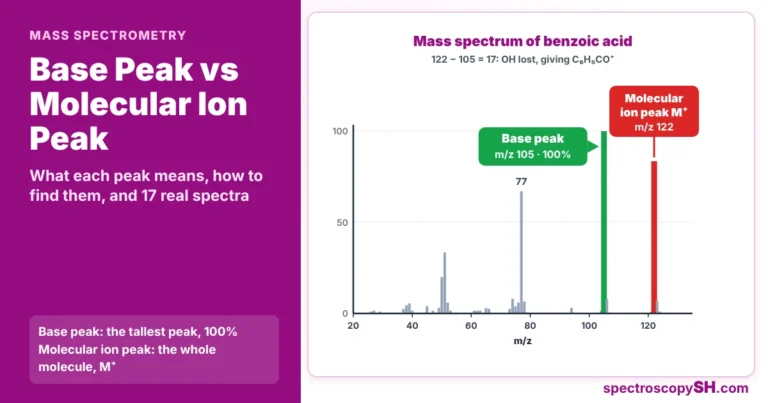
    • Base Peak and Molecular Ion Peak in Mass Spectrometry: Differences and Examples
      Mass Spectrometry

      Base Peak and Molecular Ion Peak in Mass Spectrometry: Differences and Examples

      ByDr. Shammas Din November 6, 2026November 8, 2026

      The base peak is the tallest peak in a mass spectrum, set to 100%. The molecular ion peak (M⁺) is the peak of the whole molecule, and it gives the molecular mass. The two are often different peaks: in the mass spectrum of benzoic acid, the molecular ion peak is at m/z 122, but the…

      Read More Base Peak and Molecular Ion Peak in Mass Spectrometry: Differences and ExamplesContinue

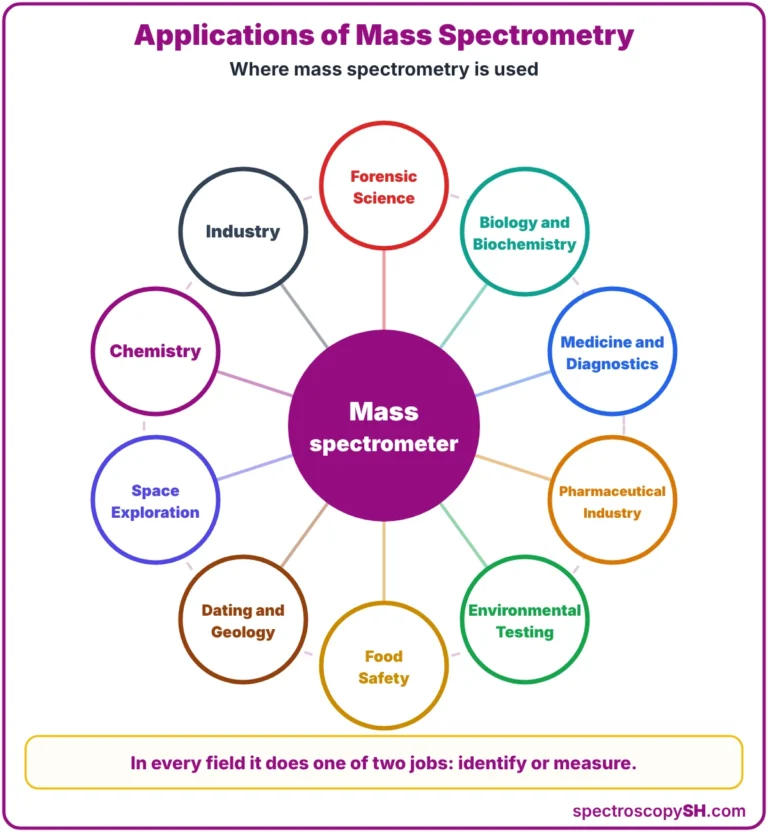
    • Diagram illustrating the major applications of mass spectrometry across different fields, including forensic science, biology and biochemistry, medicine and diagnostics, pharmaceutical industry, environmental testing, food analysis, dating and geology, space exploration, chemistry, and industrial applications.
      Mass Spectrometry

      Applications of Mass Spectrometry: Uses in Forensic Science, Biology, Medicine and More

      ByDr. Shammas Din November 4, 2026November 4, 2026

      What are the applications of mass spectrometry?Mass spectrometry is used to identify unknown compounds and to measure how much of a compound is present, even in very small amounts. The main applications of mass spectrometry are in forensic science, biology, medicine, the pharmaceutical industry, environmental and food testing, dating of rocks and fossils, space exploration,…

      Read More Applications of Mass Spectrometry: Uses in Forensic Science, Biology, Medicine and MoreContinue

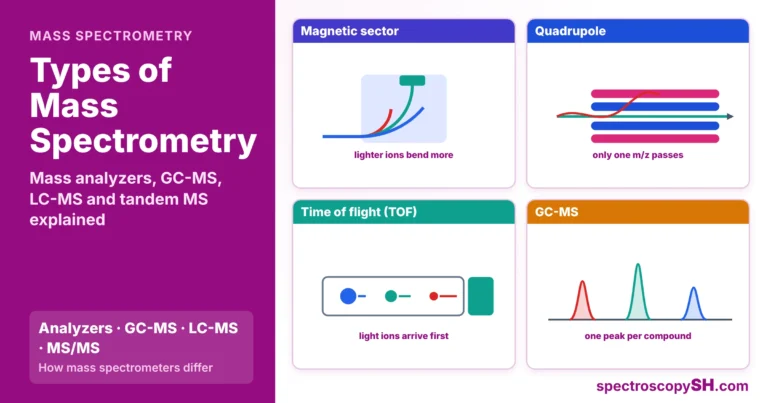
    • Types of mass spectrometry: a magnetic sector bends lighter ions more, a quadrupole lets only one m/z pass, a time-of-flight analyzer sends light ions to the detector first, and GC-MS gives one chromatogram peak per compound
      Mass Spectrometry

      Types of Mass Spectrometry: Mass Analyzers, GC-MS, LC-MS and Tandem MS Explained

      ByDr. Shammas Din October 25, 2026October 28, 2026

      Mass Spectroscopy Types (Mass Spectrometry): How Different Types of Mass Spectrometers Work Every mass spectrometer does the same job.All types of mass spectrometry turn molecules into ions, sort the ions by their mass-to-charge ratio (m/z), and count them. The result is a mass spectrum. (New to this? Start with What is Mass Spectrometry.) But each…

      Read More Types of Mass Spectrometry: Mass Analyzers, GC-MS, LC-MS and Tandem MS ExplainedContinue

    • Ionization methods in mass spectrometry: EI (hard) gives many fragments, while soft CI, MALDI and ESI keep the molecule whole, shown with small EI, CI, MALDI and ESI mass spectra
      Mass Spectrometry

      Ionization Methods in Mass Spectrometry: EI, CI, FAB, MALDI and ESI Explained

      ByDr. Shammas Din October 24, 2026October 28, 2026

      Ionization Methods in Mass Spectrometry: How Molecules Become Ions Our goal: find the mass of a molecule.Mass spectrometry tells us the molecular mass of a compound. But there is a problem: molecules are neutral, and a mass spectrometer can only measure charged particles (ions). So the first step is always to give the molecule a…

      Read More Ionization Methods in Mass Spectrometry: EI, CI, FAB, MALDI and ESI ExplainedContinue

    • Mass Spectrometry

      What is Mass Spectrometry? Principle, Parts, How It Works and Uses

      ByDr. Shammas Din October 23, 2026October 28, 2026

      Learn Mass Spectrometry: How a Mass Spectrometer Measures the m/z of Ions What is mass spectrometry, and how does a mass spectrometer work? This guide explains mass spectrometry in simple terms: its principle (m/z), the parts of a mass spectrometer, the 5 stages of how mass spectrometry works, what it is used for, and its…

      Read More What is Mass Spectrometry? Principle, Parts, How It Works and UsesContinue

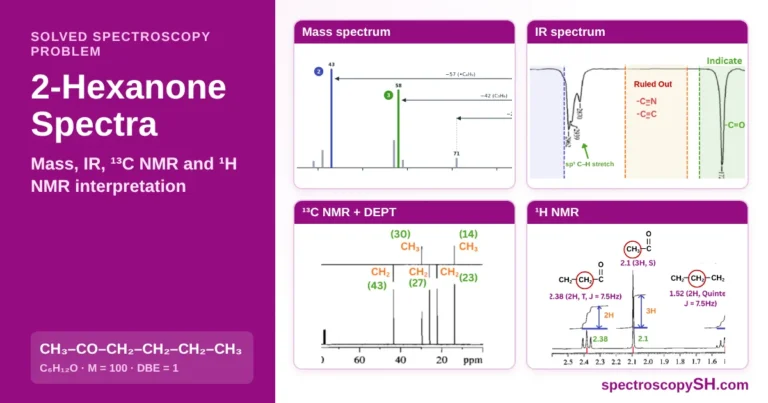
    • 2-hexanone spectra featured image showing the mass spectrum, IR spectrum, 13C NMR with DEPT and 1H NMR spectrum of 2-hexanone (C6H12O)
      Spectroscopy Problems

      Identify an Unknown Compound from Mass, IR, ¹³C and ¹H NMR Spectra: Worked Example of 2-Hexanone (C₆H₁₂O)

      ByDr. Shammas Din October 20, 2026November 12, 2026

      Can You Identify This Unknown C6H12O? A Combined Spectroscopy Problem Solved with Mass, IR, ¹³C and ¹H NMR 2-Hexanone spectra are interpreted step by step in this solved combined spectroscopy problem: the mass spectrum, IR spectrum, ¹³C NMR with DEPT and ¹H NMR spectrum of C6H12O lead to the structure elucidation of 2-hexanone. You will…

      Read More Identify an Unknown Compound from Mass, IR, ¹³C and ¹H NMR Spectra: Worked Example of 2-Hexanone (C₆H₁₂O)Continue

    Page navigation

    1 2 3 Next PageNext

    © 2026 spectroscopysh.com - WordPress Theme by Kadence WP